
Explore implant prosthetics, including materials, digital workflows, applications, benefits, and challenges in modern restorative dentistry.
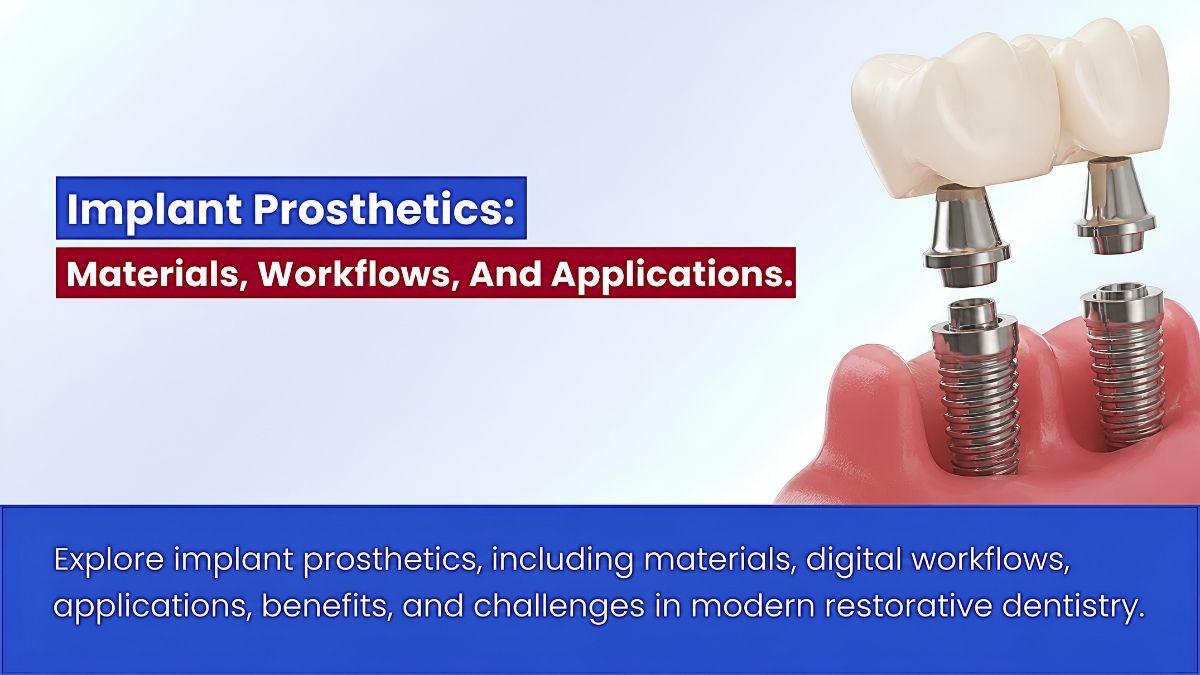
Table of contents [Show]
- What are implant prosthetics?
- Key components of implant prosthetics
- Materials used in implant prosthetics
- Technologies shaping implant prosthetics
- Applications of implant prosthetics
- Benefits of implant prosthetics
- Challenges and limitations
- Future direction of implant prosthetics
- Why implant prosthetics matter for lab-to-lab outsourcing
- Key takeaways
- References
Implant prosthetics are one of the most important areas in modern restorative dentistry because they connect surgical implant placement with final functional and aesthetic outcomes. While the implant itself serves as the artificial root, the prosthetic component is what patients ultimately use, feel, and judge every day. In practice, that means the success of implant treatment depends not only on osseointegration, but also on prosthetic planning, material selection, manufacturing accuracy, and long-term maintenance.
For dental practices, implant prosthetics are no longer limited to single-unit crowns. They now include implant-supported bridges, overdentures, full-arch restorations, hybrid prostheses, custom abutments, and digitally designed frameworks. As digital workflows continue to reshape restorative dentistry, laboratories have become even more central to the precision, consistency, and scalability of implant prosthetic treatment. This article explores what implant prosthetics are, their components, materials, technologies, applications, benefits, challenges, and future direction, with practical relevance for practices seeking dependable lab-to-lab support.
What are implant prosthetics?
Implant prosthetics are dental restorations supported by dental implants, which are surgically placed into the jawbone to replace missing tooth roots.
Core definition
An implant prosthetic restoration usually includes the implant fixture placed in bone, the abutment or prosthetic connection, and the visible restoration, such as a crown, bridge, overdenture, or full-arch prosthesis.
Together, these components restore missing teeth in a way that aims to improve function, stability, aesthetics, and long-term oral health.
Why implant prosthetics matter
Implant prosthetics are clinically significant because they can help restore chewing efficiency, improve speech, support facial structure, replace missing teeth without relying on adjacent natural teeth, improve confidence and aesthetics, and enhance stability compared with conventional removable prostheses.
In modern prosthodontics, implant treatment is not simply about placing fixtures. It is about designing a restoration that performs biologically, mechanically, and aesthetically over time.
Key components of implant prosthetics
Implant prosthetics involve several interconnected parts, and each one affects the final result.
Dental implant fixture
The implant is the component surgically placed into bone.
Role of the implant fixture
Its role is to act as an artificial tooth root, support osseointegration, and provide anchorage for the prosthetic restoration.
Most implants are made of titanium, although zirconia implants also exist in selected applications.
Abutment
The abutment connects the implant to the final restoration.
Types of abutments
Abutments may be stock or prefabricated, custom milled, titanium, zirconia, or titanium-zirconia hybrid designs.
The choice of abutment affects emergence profile, soft tissue management, aesthetics, and retention strategy.
Prosthetic restoration
This is the visible, functional part of treatment.
Depending on the indication, the prosthetic restoration may be a single crown, a multi-unit bridge, an implant-supported overdenture, a fixed full-arch prosthesis, or a hybrid restoration.
This is the component that must withstand function while looking natural and fitting precisely.
Materials used in implant prosthetics
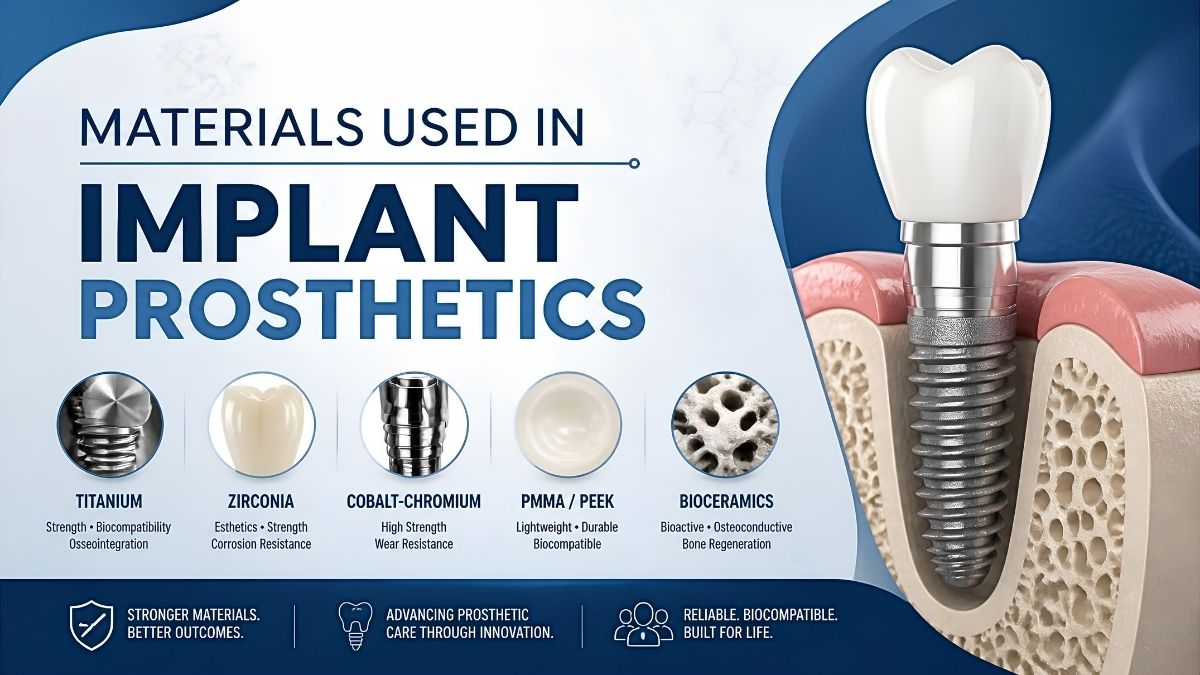
Material selection is one of the most important decisions in implant prosthetics because it influences strength, fit, wear, aesthetics, tissue response, and repairability.
Titanium
Titanium remains one of the most important materials in implant dentistry.
Advantages of titanium
Its advantages include excellent biocompatibility, strong osseointegration performance, high strength, corrosion resistance, and proven long-term clinical history.
Titanium is commonly used for implants, abutments, bars, and framework substructures.
Zirconia
Zirconia has become a leading prosthetic material in implant restorations, especially for visible zones and high-strength fixed solutions.
Benefits of zirconia
Its benefits include tooth-colored appearance, high strength, good biocompatibility, favorable soft tissue response, and suitability for crowns, bridges, and full-arch restorations.
Zirconia is especially relevant where aesthetics and monolithic strength are priorities.
Advanced ceramics
Ceramics such as lithium disilicate and zirconia-reinforced glass ceramics may be used in selected implant restorations, particularly for anterior crowns or aesthetic cases.
Clinical value of advanced ceramics
They offer good translucency, improved appearance, and suitable strength for specific indications.
However, their use depends heavily on case selection and restorative design.
Hybrid polymers and composites
Materials such as PEEK, PMMA, and reinforced composite systems are increasingly relevant in implant prosthetics.
Applications of hybrid materials
These materials may be used for provisional restorations, framework alternatives in selected cases, lightweight prosthetic designs, and shock-absorbing components.
Their appeal often lies in lower weight, reparability, and flexibility in certain restorative concepts.
Technologies shaping implant prosthetics
Implant prosthetics have been significantly transformed by digital technology. Precision is no longer just a craftsmanship issue. It is now also a workflow issue.
CAD/CAM design and manufacturing
CAD/CAM is central to modern implant prosthetics because it allows digital design of crowns, bridges, bars, and frameworks, more accurate customization, better reproducibility, improved fit consistency, and more efficient manufacturing.
It is especially important for custom abutments and implant-supported frameworks.
3D printing
3D printing supports implant workflows in multiple ways, including surgical guides, printed models, prototype prostheses, temporary restorations, and casting patterns.
As printing technologies improve, they continue to increase speed and customization options.
Digital workflows
Digital workflows improve communication among clinician, surgeon, and laboratory.
Common digital workflow elements
These workflows may include intraoral scanning, implant scan bodies, virtual design review, digital smile planning, and prosthetic verification steps.
This helps reduce manual errors and improve case predictability.
Guided surgery and planning software
Guided systems help align prosthetic planning with implant placement.
This matters because successful implant prosthetics often begin with prosthetically driven treatment planning rather than placing implants first and adjusting afterward.
Applications of implant prosthetics
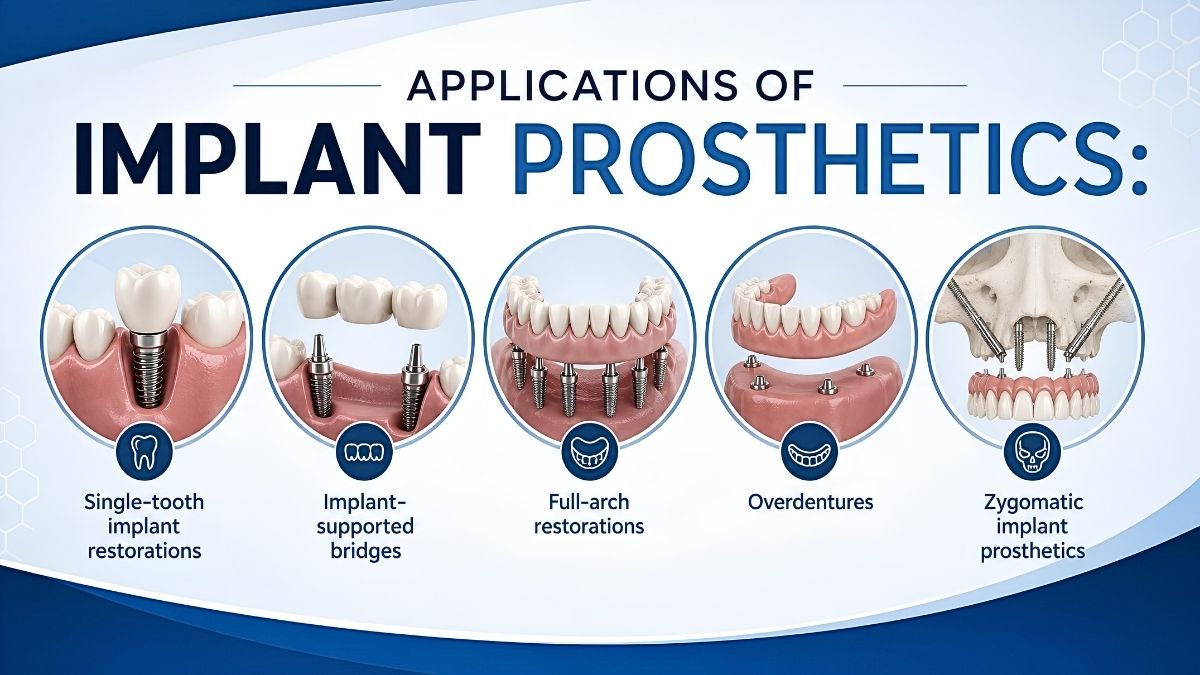
Implant prosthetics are used across a wide range of restorative scenarios.
Single-tooth implant restorations
These replace one missing tooth with an implant-supported crown.
Why they are commonly chosen
They are often preferred because they preserve adjacent teeth, offer strong functional replacement, provide natural-looking aesthetics, and support localized bone preservation.
Implant-supported bridges
These replace multiple missing teeth using implants as anchors.
Clinical advantages of implant-supported bridges
Compared with traditional bridges, they may avoid unnecessary preparation of adjacent natural teeth and improve distribution of functional load.
Full-arch restorations
Full-arch implant prosthetics include solutions such as All-on-4, All-on-6, fixed hybrid prostheses, monolithic zirconia arches, and implant-supported full-arch bridges.
These are particularly relevant for edentulous patients and full-mouth rehabilitation cases.
Overdentures
Implant-supported overdentures are removable prostheses retained by implants.
Benefits of overdentures
They offer better retention than conventional dentures, greater patient comfort, improved confidence during speaking and eating, and easier hygiene access compared with some fixed options.
Zygomatic implant prosthetics
For cases with severe maxillary bone loss, zygomatic implants may support advanced prosthetic rehabilitation.
These cases require especially strong planning, communication, and framework precision.
Benefits of implant prosthetics
Implant prosthetics deliver several major benefits for both patients and clinicians.
Functional improvement
They can restore efficient chewing, clearer speech, better prosthesis stability, and more natural bite function.
Aesthetic improvement
When well designed, implant prosthetics can provide natural emergence profile, improved smile appearance, better facial support, and restoration of confidence.
Bone preservation support
Because implants transfer load to bone, they help preserve alveolar bone better than many conventional tooth replacement options.
Long-term restorative value
With good planning, manufacturing, and maintenance, implant prosthetics can offer durable and predictable long-term outcomes.
Challenges and limitations
Despite their advantages, implant prosthetics also involve important challenges.
Cost and complexity
Implant treatment often includes surgical procedures, advanced restorative planning, laboratory customization, premium materials, and multiple appointments.
This can increase both clinical complexity and treatment cost.
Technical sensitivity
Implant restorations are highly technique-sensitive.
Potential technical complications
Potential problems include misfit, screw loosening, fracture, occlusal overload, aesthetic mismatch, and soft tissue complications.
Even small inaccuracies can create major clinical consequences.
Maintenance requirements
Implant prosthetics still require hygiene care, recall appointments, occlusal evaluation, component monitoring, and occasional repair or replacement.
They are durable, not maintenance-free.
Case selection
Not every patient is an ideal candidate for every implant prosthetic option. Bone quality, anatomy, parafunction, medical history, and financial considerations all influence treatment choice.
Future direction of implant prosthetics
Implant prosthetics continue to evolve rapidly, especially as materials and digital tools improve.
Emerging materials
Future development is likely to expand in bioactive ceramics, improved zirconia formulations, hybrid composites, more durable provisional materials, and surface-enhanced prosthetic components.
AI-assisted planning
Artificial intelligence is increasingly being explored for restorative planning, margin detection, occlusal analysis, design automation, and workflow efficiency.
This may reduce manual variation and improve consistency.
Sustainability in manufacturing
Dental laboratories are also under pressure to improve sustainability through better material utilization, reduced remakes, efficient digital manufacturing, and lower-waste production methods.
Stronger global lab collaboration
Cross-border digital collaboration is becoming easier, which means dental practices can work with specialized laboratories worldwide while maintaining high standards of communication and quality control.
Why implant prosthetics matter for lab-to-lab outsourcing
For dental practices, implant prosthetics often reveal the true capability of a laboratory. These cases demand precision, material knowledge, digital fluency, and consistency.
What practices need from a lab partner
Practices need implant prosthetic partners who can provide accurate fit, material expertise, custom abutment and framework support, reliable communication, efficient turnaround, and consistent quality control.
Relevance to XDENT LAB
For XDENT LAB, implant prosthetics are a core area of expertise within its removable and implant service portfolio. As a Vietnam dental lab focused on lab-to-lab service and dental lab outsourcing, XDENT LAB supports practices seeking dependable implant restorations aligned with U.S. expectations.
With FDA and ISO-oriented quality systems, certified technicians, advanced manufacturing technology, and growing global operational capacity, XDENT LAB is positioned to support implant prosthetic workflows that require precision, scalability, and consistent production standards.
Key takeaways
Implant prosthetics are the restorative components supported by dental implants, and they play a decisive role in the functional, biological, and aesthetic success of implant treatment. Their effectiveness depends on the correct integration of implant planning, prosthetic design, material selection, manufacturing accuracy, and long-term maintenance.
From single-tooth crowns to full-arch restorations, implant prosthetics continue to evolve through CAD/CAM, 3D printing, advanced ceramics, titanium frameworks, and digital collaboration. For dental practices evaluating outsourcing options, the right lab partner is not simply producing parts. It is helping translate surgical placement into durable restorative success.
References
Share this post:
Related Posts
Explore lab-to-lab workflow and QC for implant-supported fixed prostheses, from fit and materials to retrievability, hygiene design, and consistency.
Explore lab workflow and quality standards for inlays, onlays, and overlays to improve fit, occlusion, durability, and restorative consistency.
Explore veneer laboratory workflow, shade control, and quality checks in prosthodontics for predictable esthetics, fit, bonding, and long-term results.

