
Explore restorative dentistry procedures, benefits, materials, and digital trends that help restore function, replace missing teeth, and support long-term oral health.
Table of contents [Show]
- What is restorative dentistry?
- Main procedures in restorative dentistry
- Benefits of restorative dentistry
- Materials used in restorative dentistry
- Treatment planning principles in restorative dentistry
- Digital transformation in restorative dentistry
- Challenges in restorative dentistry
- Why dental lab partnership matters in restorative dentistry
- Emerging trends and future directions
- Key takeaways
Restorative dentistry is one of the central disciplines in modern dental care because it focuses on rebuilding teeth, restoring oral function, and preserving long-term health. It covers a wide range of treatments used to repair damaged teeth, replace missing teeth, and improve how the oral system performs during chewing, speaking, and daily use. While many restorative procedures also improve appearance, their core purpose is functional rehabilitation and structural preservation.
For dental practices, restorative dentistry is not only a clinical service category. It is also a decision-making framework that connects diagnosis, treatment planning, materials, laboratory collaboration, patient expectations, and long-term maintenance. From simple fillings to implant-supported restorations and removable prosthetics, restorative care depends on precision at every stage. This article explains what restorative dentistry is, its major procedures, benefits, materials, clinical challenges, digital innovations, and why a reliable dental lab partner is critical to predictable restorative outcomes.
What is restorative dentistry?
Restorative dentistry is the branch of dentistry focused on diagnosing, managing, and treating defects, decay, trauma, and tooth loss affecting the teeth and their supporting structures.
Core purpose
The main goals of restorative dentistry are to:
- Restore function
- Preserve tooth structure where possible
- Replace missing teeth
- Improve comfort and occlusion
- Support long-term oral health
- Enhance appearance when clinically appropriate
In practice, restorative dentistry often overlaps with prosthodontics, endodontics, periodontics, implant dentistry, and cosmetic dentistry.
Scope of treatment
Restorative care may address:
- Dental caries
- Fractured teeth
- Worn dentition
- Endodontically treated teeth
- Missing single teeth
- Partial tooth loss
- Full-arch tooth replacement needs
- Structural defects affecting mastication or speech
This broad scope makes restorative dentistry one of the most clinically significant and interdisciplinary areas of dental treatment.
Main procedures in restorative dentistry
Restorative dentistry includes both direct and indirect treatment approaches depending on the extent of damage, material requirements, and functional demands.
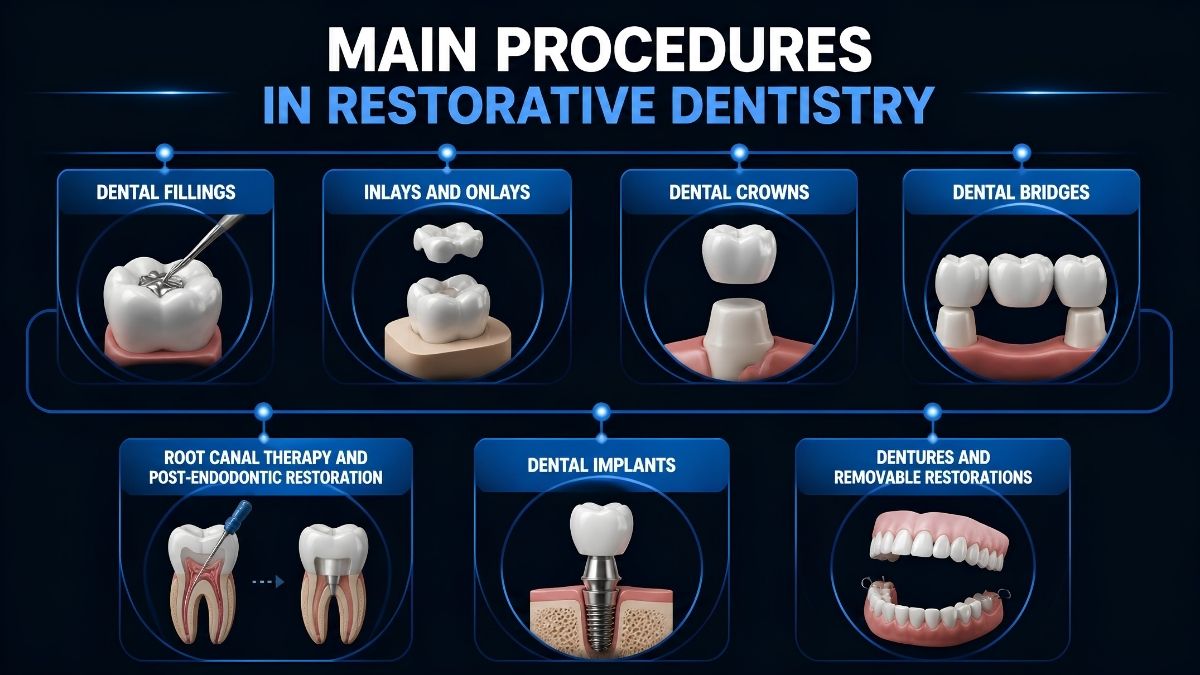
Dental fillings
Dental fillings are among the most common restorative procedures.
When fillings are used
They are typically indicated for:
- Carious lesions
- Small fractures
- Defects caused by wear
- Replacement of old defective restorations
Common filling materials
These may include:
- Composite resin
- Glass ionomer
- Resin-modified glass ionomer
- Amalgam in selected settings
The choice of material depends on location, isolation, load, esthetics, and long-term treatment goals.
Inlays and onlays
Inlays and onlays are indirect restorations used when a tooth is too damaged for a simple filling but does not require a full crown.
Clinical value
They help:
- Preserve more natural tooth structure
- Reinforce weakened cusps
- Improve fit and contour
- Provide durable posterior restoration in selected cases
Dental crowns
Crowns are full-coverage restorations designed to restore the shape, strength, and function of compromised teeth.
Common indications
Crowns are often used for:
- Severely decayed teeth
- Fractured teeth
- Root canal treated teeth
- Teeth with large existing restorations
- Teeth requiring occlusal rehabilitation
Common crown materials
These may include:
- Zirconia
- Porcelain-fused-to-metal
- Lithium disilicate
- Full metal in selected posterior applications
Dental bridges
Dental bridges replace one or more missing teeth by using adjacent abutment teeth or implants for support.
Why bridges are used
Bridges can help restore:
- Occlusal continuity
- Chewing efficiency
- Speech function
- Arch stability
- Smile appearance
They remain relevant when implant placement is not preferred or when fixed replacement is desired without removable prosthetics.
Root canal therapy and post-endodontic restoration
Restorative dentistry often works closely with endodontics.
Role in tooth preservation
After root canal treatment, the tooth usually requires restorative protection to prevent fracture and restore function. Depending on the case, this may involve:
- Direct buildup
- Post and core
- Full-coverage crown
- Cuspal coverage restoration
Dental implants
Dental implants are a major component of contemporary restorative treatment planning.
Restorative significance
They provide support for:
- Single crowns
- Implant bridges
- Full-arch prostheses
- Implant-assisted removable restorations
Although implant placement is surgical, the restorative phase determines emergence profile, occlusion, esthetics, cleansability, and final function.
Dentures and removable restorations
Removable prosthetics are an important part of restorative dentistry, especially in cases of multiple missing teeth or full-arch rehabilitation.
These include:
- Complete dentures
- Removable partial dentures
- Implant-retained overdentures
- Transitional removable prostheses
For many patients, removable restorative solutions remain practical, cost-effective, and clinically appropriate.
Benefits of restorative dentistry
Restorative dentistry provides value far beyond simple repair. It supports the overall integrity of the oral system.
Functional rehabilitation
One of the main benefits is restoration of oral function.
Restored abilities may include
- Efficient chewing
- Clearer speech
- More stable occlusion
- Better comfort during function
Structural preservation
Timely restorative treatment can preserve teeth that might otherwise be lost.
Why this matters
Preserving natural teeth often helps maintain:
- Bone support
- Occlusal stability
- Arch integrity
- More conservative future treatment options
Aesthetic improvement
Although function comes first, many restorative procedures also improve the appearance of the smile.
Aesthetic benefits may include
- Better tooth form
- Improved shade integration
- Replacement of missing visible teeth
- More harmonious smile balance
Prevention of further damage
Restorations help stop disease progression and reduce the consequences of structural compromise.
Preventive impact
They may help prevent:
- Deeper decay
- Tooth fracture
- Tooth migration after tooth loss
- Occlusal collapse
- Soft tissue irritation from unstable dentition
Long-term oral health support
Well-planned restorative treatment supports overall oral health by restoring balance and maintainability.
Materials used in restorative dentistry
Material selection is one of the most important decisions in restorative care because it affects longevity, esthetics, strength, and laboratory workflow.
Composite resin
Composite resin is commonly used in direct restorations.
Key advantages
It offers:
- Tooth-colored esthetics
- Conservative preparation
- Good versatility
- Suitable use in many anterior and posterior applications
Glass ionomer materials
Glass ionomer and related materials are useful in selected restorative situations.
Typical benefits
They may provide:
- Fluoride release
- Chemical adhesion
- Utility in cervical or low-stress areas
- Value in pediatric or transitional applications
Ceramics
Ceramic materials are widely used in indirect restorative dentistry.
Common ceramic categories
These include:
- Zirconia
- Lithium disilicate
- Feldspathic porcelain in selected esthetic applications
Why ceramics matter
They are valued for:
- Esthetics
- Biocompatibility
- Strength in selected indications
- Precision in digital workflows
Although all-ceramic options continue to grow, metal-based restorations remain relevant in certain clinical situations.
Ongoing indications
These materials may still be chosen for:
- High-load posterior areas
- Long-span bridges in selected cases
- Specific functional demands
- Established clinical preference
Treatment planning principles in restorative dentistry
Successful restorative outcomes begin with correct diagnosis and careful planning.
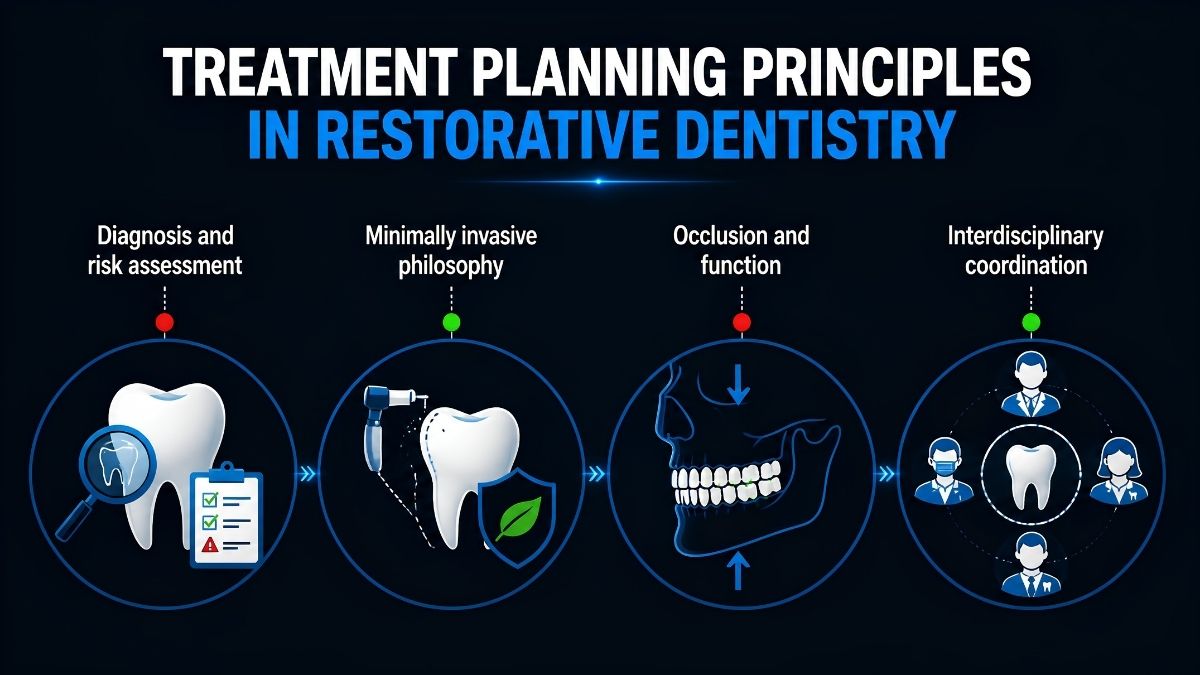
Diagnosis and risk assessment
Every restoration should be planned in the context of the patient’s full oral condition.
Key factors include
- Caries risk
- Periodontal status
- Occlusion
- Parafunction
- Pulpal status
- Remaining tooth structure
- Patient expectations
- Hygiene capability
Minimally invasive philosophy
Modern restorative care emphasizes preservation whenever possible.
In practice, this means
- Removing as little healthy tooth structure as possible
- Choosing adhesive options when appropriate
- Avoiding overtreatment
- Planning restorations that support long-term tooth survival
Occlusion and function
A restoration must work within the patient’s occlusal system.
Clinical importance
If occlusal design is ignored, problems may include:
- Fracture
- Wear
- Discomfort
- Instability
- Failure of restorative materials
Interdisciplinary coordination
Many restorative cases require collaboration across disciplines.
Common intersections
Restorative treatment may need coordination with:
- Endodontics
- Periodontics
- Orthodontics
- Oral surgery
- Implant dentistry
- Prosthodontics
- Dental laboratory teams
Digital transformation in restorative dentistry
Digital dentistry has reshaped how restorative treatment is planned, designed, communicated, and manufactured.
Intraoral scanning
Digital impressions improve efficiency and case communication in many restorative workflows.
Main advantages
They can support:
- Faster data capture
- Improved patient experience
- Better communication with the lab
- Easier record storage
- Workflow integration with CAD systems
CAD/CAM restorations
Computer-aided design and manufacturing are central to modern restorative production.
Applications
CAD/CAM may be used for:
- Crowns
- Bridges
- Inlays and onlays
- Implant restorations
- Surgical and restorative planning integration
3D printing and model production
3D printing supports restorative workflows indirectly and directly.
Common uses
It may be used for:
- Working models
- Surgical guides
- Provisional restorations
- Wax-up support
- Communication tools for treatment planning
AI and future planning tools
Artificial intelligence is beginning to influence restorative diagnostics and workflow management.
Future potential
AI may support:
- Caries detection
- Margin analysis
- Occlusal evaluation
- Treatment planning efficiency
- Quality control in digital production pipelines
Challenges in restorative dentistry
Restorative dentistry offers major benefits, but success depends on managing several clinical and operational challenges.
Material and technique sensitivity
Many restorative materials perform well only when used under correct clinical conditions.
Common variables
Outcomes may be affected by:
- Moisture control
- Preparation design
- Bonding accuracy
- Occlusal loading
- Laboratory precision
Cost and case complexity
Some restorative solutions, especially complex fixed and implant cases, require substantial financial and technical resources.
Patient compliance
Long-term success is strongly influenced by patient behavior.
Important compliance factors
These include:
- Oral hygiene
- Recall attendance
- Nightguard use where needed
- Maintenance of implants or prostheses
- Dietary habits in high-risk patients
Technology adaptation
Dental teams must continuously adapt to new materials, software, equipment, and workflows.
This creates opportunities, but also requires training, calibration, and strong collaboration between clinic and laboratory.
Why dental lab partnership matters in restorative dentistry
Restorative success is not achieved by the clinic alone. Laboratory execution plays a direct role in fit, function, esthetics, material performance, and turnaround consistency.
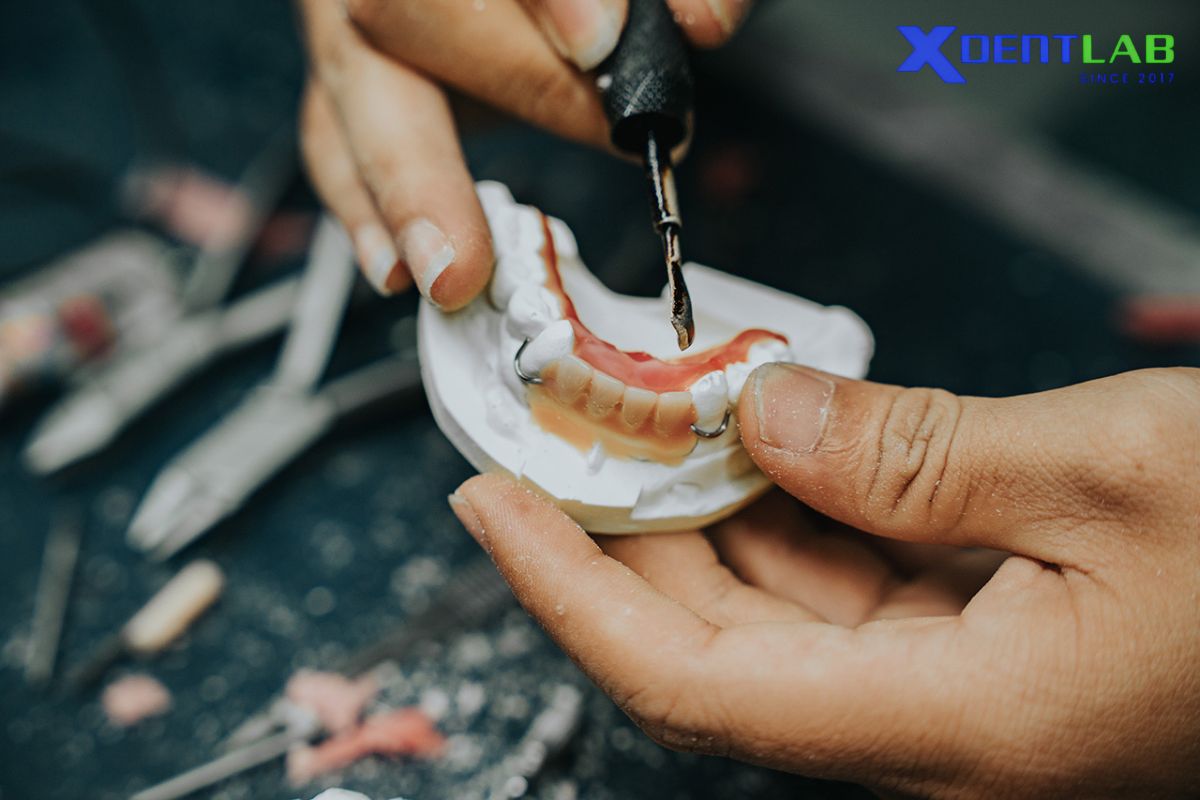
What dental practices need from a lab
A trusted dental lab partner should provide:
- Accurate fabrication
- Material expertise
- Reliable communication
- Consistent quality control
- Support for digital and conventional workflows
- Experience with removable and implant-related restorative cases
Relevance to XDENT LAB
For practices looking for a Vietnam dental lab with dependable lab-to-lab service, XDENT LAB brings strong relevance to restorative dentistry through its focus on removable and implant workflows, FDA and ISO alignment, advanced production capabilities, and scalable quality systems.
Because restorative care often depends on timing, consistency, and technical precision, outsourcing to an experienced dental laboratory can help practices reduce remakes, improve predictability, and maintain a higher standard of patient care. This is especially important when managing complex restorative cases that combine prosthetics, implants, digital records, and long-term functional demands.
Emerging trends and future directions
Restorative dentistry continues to evolve through changes in materials, techniques, and digital integration.
Biomimetic dentistry
Biomimetic principles aim to restore teeth in ways that better replicate natural biomechanics and structure.
Personalized restorative workflows
Digital tools are enabling more patient-specific restorative planning and production.
Sustainability and material innovation
Future development is likely to include stronger, more efficient, and potentially more sustainable restorative materials and workflows.
Greater integration across diagnosis and manufacturing
The future of restorative dentistry will likely involve tighter connections between:
- Clinical imaging
- Digital planning
- AI-assisted diagnostics
- Laboratory CAD design
- Automated manufacturing systems
Key takeaways
Restorative dentistry is the area of dental care focused on repairing damaged teeth, replacing missing teeth, and restoring oral function, structure, and long-term health. It includes procedures such as fillings, crowns, bridges, implants, root canal-related restorations, and removable prosthetics.
Its success depends on accurate diagnosis, appropriate material selection, sound occlusal planning, and excellent coordination between the dental practice and the laboratory. For practices seeking reliable restorative outcomes, partnering with an experienced outsourcing provider such as XDENT LAB can support consistency, quality, and scalability across modern restorative workflows.
About XDENT LAB:
We are experts in Lab-to-Lab Full Service from Vietnam, with the signature services of Removable, meet U.S. market standards, FDA-registered, ISO 13485-certified. Founded in 2017, from local root to global reach, we scale with 2 Factories with over 100+ employees.
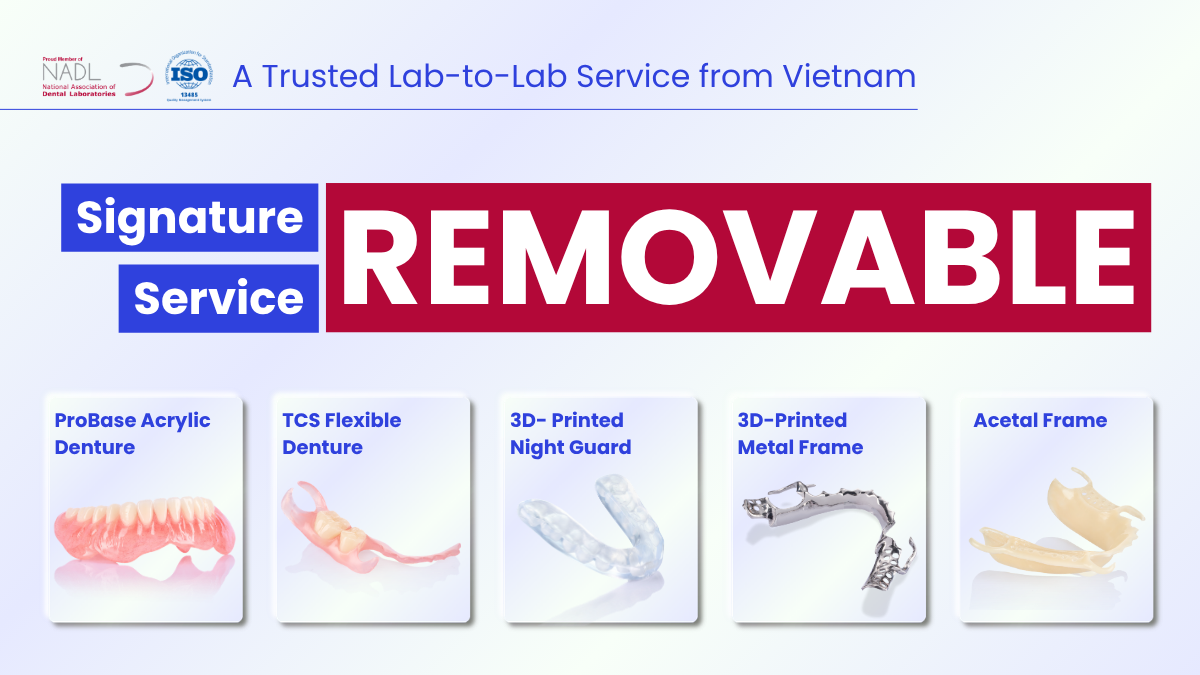
Our Commitments Built on “Trusted. Commitment. Quality”
- Commit to Large-Scale Manufacturing, high volume, remake rate < 1%.
- Commit to 5-Year Warranty
- Commit to Competitive Price
XDENT LAB | A Trusted Lab-to-Lab Service from Vietnam
Share this post:
Related Posts
A practical guide to implant crowns, bridges and overdentures, covering materials, component compatibility and laboratory workflow.
Explore the types, materials, retention methods and lab workflows for maxillofacial removable prostheses, with practical guidance for dental practices.
Explore precision attachment denture types, benefits and limitations, plus key considerations for design, fabrication and maintenance in dental practices.

