
A practical guide to removable prosthetics outsourcing: compare lab partners, manage production risks and calculate the true cost per case.
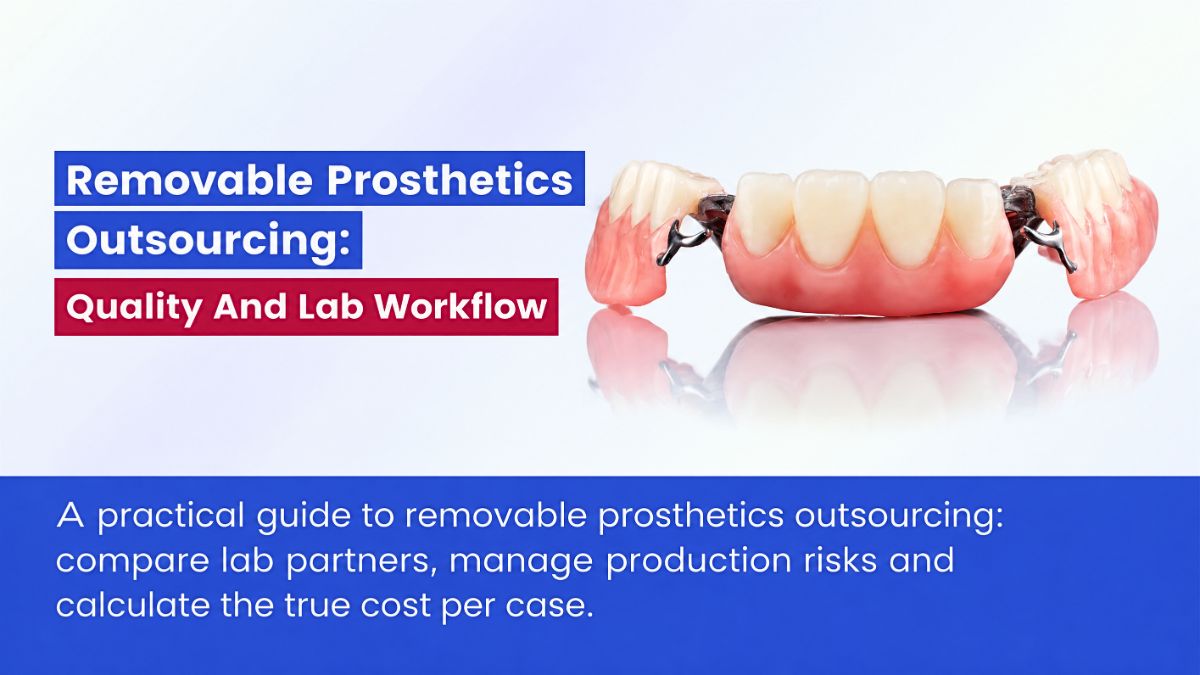
Table of contents [Show]
Removable prosthetics outsourcing means assigning some or all denture-production work to an external laboratory, design team or manufacturing center. A practice or laboratory may outsource to gain specialist skills, additional capacity or access to CAD/CAM equipment. The arrangement succeeds, however, only when the finished prosthesis still meets the approved clinical design and can be traced, inspected and serviced.
For dental practices, the key question is not simply, “Can another laboratory make it?” It is which steps can be transferred without losing control of fit, materials, communication and patient care. This guide covers common outsourcing models, removable-prosthesis workflows, supplier qualification, regulatory responsibilities and the true cost of an accepted case.
What can be outsourced in removable prosthetics?
Outsourcing is a manufacturing arrangement, not a type of denture. Its scope can range from one CAD design to a finished appliance.
Products and production stages
Different products require different levels of clinical input and verification.
| Product or service | Common outsourced work | Critical control |
|---|---|---|
| Complete dentures | Tooth setup, try-ins, base processing, milling or printing | Jaw relations, tooth position, base extension and material approval |
| Removable partial dentures | Framework design or manufacture, tooth setup and processing | Authorized design, rest seating, insertion path and framework fit |
| Flexible partial dentures | Thermoplastic processing and finishing | Material indication, support and repair or reline limitations |
| Implant overdentures | Bars, frameworks, denture bases and attachment integration | Exact component identity, support concept and verified fit |
| Maxillofacial removable devices | Selected frameworks, bases, patterns or molds | Specialist prescription and staged functional verification |
| Repairs and relines | Base repair, tooth replacement or reprocessing | Material compatibility, infection control and turnaround |
Outsourcing a standard denture base is not equivalent to outsourcing a milled implant bar or definitive obturator. As complexity increases, so does the need for explicit design approvals and clinical–laboratory checkpoints.
Which outsourcing model fits the work?
The right model depends on case volume, local capabilities and how much production control the commissioning team needs to retain.
| Model | What the external partner does | Main trade-off |
|---|---|---|
| Full-service | Produces the finished appliance | Reduces production work but increases supplier dependence |
| Stage-specific | Produces a framework, bar, base or other defined component | Preserves local control but adds handoffs |
| Design-only | Creates a CAD proposal for approval | Requires clear design authorization and version control |
| Manufacturing-only | Makes an already approved design | Requires validated equipment and production controls |
| Overflow or specialist | Handles peak volume or selected complex cases | Requires consistent specifications across suppliers |
One practical arrangement is to retain case planning, clinical approvals, customer communication and final inspection locally while outsourcing equipment-intensive manufacture. It is an operational option—not a model proven superior for every laboratory.
Does domestic or offshore production determine quality?
No. Domestic outsourcing may simplify site visits, shipping and communication. Offshore outsourcing may provide additional capacity or specialist production infrastructure. Either can perform well or poorly.
For cross-border work, assess customs and transit times, import responsibilities, patient-data transfers, material substitutions, subcontracting and the practical handling of remakes. Qualify the actual facility and process, not the country label.
Research directly comparing the clinical outcomes of outsourced and in-house removable prostheses is limited. More relevant evidence concerns the quality of communication. A 2024 study of clinic–laboratory information systems examined communication and prescription completion in its setting; a 2023 qualitative study explored clinician–technician relationships. Neither establishes that offshore or digital production is inherently better. Both reinforce a practical point: distance makes an incomplete prescription harder to resolve.
How to control design, materials and manufacturing
“High quality” is an aspiration. An approved design, specified material, verified production process and documented acceptance check are controls a team can use.
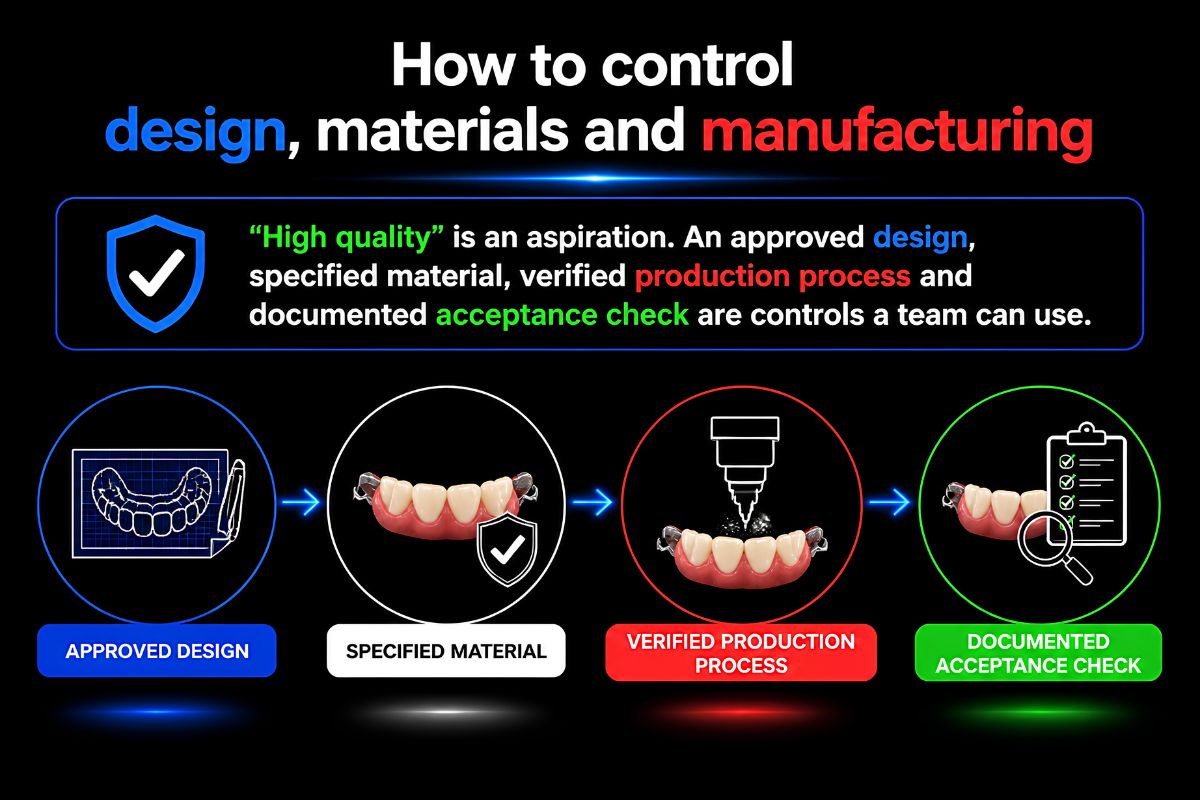
Outsourcing manufacture should not silently transfer treatment decisions to a production technician. The technician can recommend changes, but the responsible clinician must approve clinical design decisions in accordance with applicable professional rules.
For a complete denture, the prescription should address the jaw relation, vertical dimension, occlusal plane, tooth position, lip support, tooth selection, base contours and planned try-in. For a removable partial denture, it should identify the intended support, rests, major connector, retention, guide planes, insertion path and relevant mouth preparations.
A proposed change should return for approval before manufacture. An urgent due date is not authorization to substitute a different design.
What belongs in the case-transfer package?
A complete transfer gives the supplier enough information to produce the approved device and identify what still needs clarification.
- Case identification: coded patient identifier, prescriber, commissioning laboratory, product and due date.
- Clinical records: impressions or scans, opposing arch, jaw relations, photographs and existing prosthesis information when relevant.
- Approved design: prescription, marked survey or CAD file, tooth setup instructions and authorization status.
- Materials and components: exact product names, shades, alloys, attachments and permitted manufacturing routes.
- Verification stages: design review, try-in, framework assessment and final acceptance responsibilities.
- Aftercare: repair, reline, replacement-part and remake expectations.
For an implant overdenture, also specify the implant manufacturer, connection, platform, abutment level, attachment model, cuff height, scan body and CAD library. State whether the denture is intended to be mainly tissue-supported, to share support or to receive most support from an implant superstructure. Similar-looking components are not proof of compatibility.
How should material substitutions be handled?
Require product-specific identification. Descriptions such as “premium acrylic” or “medical-grade resin” do not establish intended use, processing compatibility or traceability.
For critical materials and components, obtain the manufacturer, trade name, applicable intended use, lot or batch, instructions for use and relevant regulatory documentation for the destination market. Confirm how the material can be bonded, repaired and relined.
Substitutions—including resin, artificial teeth, alloy, attachment insert, bonding agent or production method—should require written approval before use. A safety data sheet helps with handling; it does not by itself establish that a finished denture is suitable for long-term patient contact.
What changes with conventional, milled and printed dentures?
Each manufacturing route calls for its own supplier checks.
| Method | Check the supplier’s control of | Do not assume |
|---|---|---|
| Conventional processing | Material proportioning, polymerization, distortion, finishing and post-processing occlusion | A familiar material guarantees an accurate finished base |
| Milling | Blank identity, CAD thickness, tool condition, machining limits and tooth-to-base bonding | Every milled blank uses the same repair protocol |
| 3D printing | Validated resin–printer combination, orientation, washing, drying, post-curing and finishing | Approval of a resin covers every printer or curing cycle |
A printed try-in material is not automatically suitable for a definitive prosthesis. Likewise, evidence about a manufacturing method does not establish that an outsourcing arrangement using that method delivers better clinical outcomes.
How should outsourced frameworks be inspected?
For a removable partial denture framework, check the approved design against the delivered framework: alloy identity, major connector, rest seats, clasp position, tissue-contacting surfaces and fit to the verified master model. Review visible defects, finishing and any manufacturing-route requirements.
Metal printing introduces controls such as powder handling, build orientation, support removal and post-processing. Casting and milling have different potential sources of error. A distorted framework should be investigated, not made to fit through indiscriminate grinding.
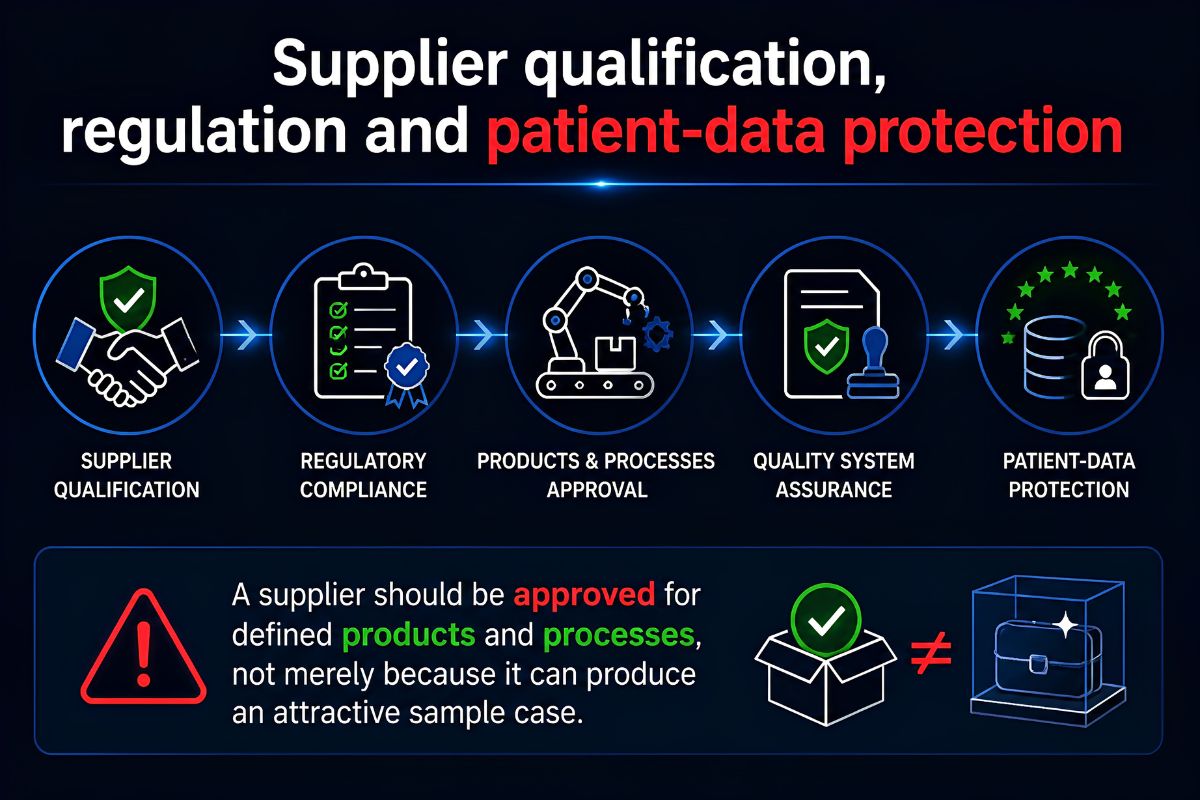
Supplier qualification, regulation and patient-data protection
A supplier should be approved for defined products and processes, not merely because it can produce an attractive sample case.
How do you qualify a removable-prosthetics partner?
Use a staged process:
- Verify the organization: Confirm the legal entity, production address, relevant registrations, certifications and disclosed subcontractors.
- Review capabilities: Assess technicians, equipment, materials, validated processes, capacity and repair support.
- Run representative pilot cases: Include varied anatomy and products rather than relying on a demonstration case chosen by the supplier.
- Check at defined gates: Accept the records, approve the design, verify try-in or framework stages, and inspect the finished device.
- Approve a limited scope: Specify the products, materials and manufacturing routes the supplier may provide.
- Monitor performance: Track documentation, fit, adjustment, delivery, complaints and remakes.
A missing record or approval should stop production until resolved. Clear hold points are more useful than discovering an assumption after the prosthesis arrives.
Who is responsible for regulatory compliance?
That depends on the destination market, product, labeling and activities performed by each business. A contract can assign tasks, but it cannot erase duties imposed by law.
United States
FDA establishment registration and device-listing requirements depend on the establishment’s activities and applicable exemptions. It is inaccurate to say that every dental laboratory must register simply because it fabricates dentures. Start with the FDA’s establishment-role guidance.
The FDA also has a product-classification entry for foreign-laboratory-manufactured full dentures. It is specific to that device category and should not be generalized to every removable appliance. FDA registration is not FDA approval; neither an establishment registration nor an ISO certificate demonstrates that each finished prosthesis has received individual regulatory approval.
The FDA’s Quality Management System Regulation became effective in February 2026. Its applicability should be assessed for the particular establishment and devices. State prescription, laboratory and material-disclosure rules may also apply.
European Union and United Kingdom
In the EU, a qualifying custom-made device follows a dedicated pathway under the Medical Devices Regulation. The European Commission’s custom-made-device overview explains the role of an authorized person’s written instruction and patient-specific design characteristics. MDCG 2021-3 clarifies distinctions among custom-made, adaptable and patient-matched devices. A product made from a scan is not automatically a custom-made device under the regulation.
Legal manufacturer identification, technical documentation and other obligations still matter when fabrication is subcontracted. Qualifying custom-made devices generally do not receive a CE mark through the custom-made-device route.
For the UK, check current MHRA registration and market guidance separately for Great Britain and Northern Ireland. Background articles on post-Brexit custom-made-device legislation and practical custom-device questions are useful context, but current official guidance should govern operational decisions.
Which standards help assess a supplier?
Depending on the products supplied, relevant standards may include ISO 13485 for medical-device quality management, ISO 14971 for risk management, ISO 20795-1 for denture-base polymers, ISO 22112 for artificial teeth, ISO 22674 for applicable dental metallic materials, and ISO 7405 or the ISO 10993 series for biological evaluation. Check current editions and scopes through ISO.
When reviewing a certificate, confirm the named legal entity, facility address, covered activities, validity and certification body. ISO 13485 certification supports assessment of a quality-management system; it does not certify the clinical fit of every denture.
How should physical items and digital files be transferred?
Impressions, prostheses and related items need a documented infection-control and packaging process. Record decontamination performed before shipment, protect items against damage and distinguish clean from contaminated receiving workflows.
For digital files, use the minimum necessary patient information, controlled access and secure transfer. Establish rules for cross-border transfers, cloud services, subcontractors, retention, deletion and secondary data use. Removing a patient’s name from a scan does not necessarily make that scan anonymous.
Cost, contracts and long-term performance
The lowest manufacturing fee may not produce the lowest cost per usable case. A reliable decision includes inspection, adjustments, shipping, remakes and aftercare.
What is the total cost per accepted case?
Compare supplier fees alongside shipping and import costs, design-review time, local finishing, extra appointments, delays and expected rework. For in-house production, include labor, equipment, software, maintenance and unused capacity.
For example, a supplier charging $110 to manufacture a case may cost more overall than one charging $150 if the lower-fee option requires more shipping, adjustment and rework. These figures are illustrative, not market pricing. The useful measure is total cost per accepted case, with comparable product types and complexity.
What should the quality agreement specify?
A written agreement should define authorized products and facilities, materials, design approvals, subcontracting, legal roles, acceptance criteria, turnaround, change control, complaints, remakes, traceability, data security and business continuity.
Specify when the turnaround clock begins: on receipt of a shipment, acceptance of complete records or final design approval. Define what a “no-charge remake” covers, including shipping and any local work. A remake policy should also distinguish manufacturing defects from changed clinical conditions or incomplete source records.
Which performance measures are useful?
Track first-pass acceptance, framework fit, prescription compliance, adjustment time, on-time arrival, documentation completeness, complaints and early repairs. Record why a case needed rework: clinical-record error, design issue, manufacturing defect, shipping damage or biological change.
A remake is an event, not automatically proof of supplier failure. Compare suppliers handling similar case types, and use recurring reason codes to decide whether to change the prescription, clinical record, production process or partner.
Where does XDENT LAB fit?
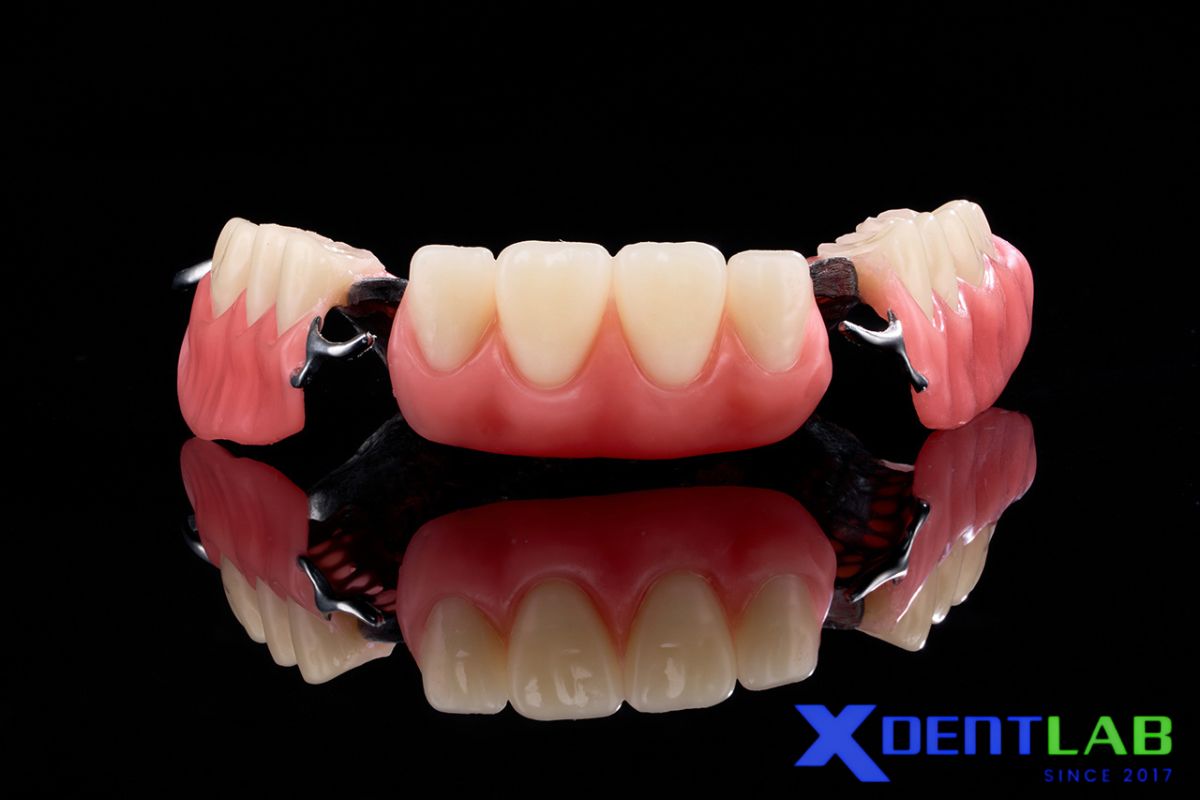
As a Vietnam-based lab-to-lab service provider with removable and implant workflows, XDENT LAB can be evaluated as an outsourcing partner for defined prosthetic products or production stages. Dental practices and commissioning laboratories should confirm the exact facility, materials, supported processes, documentation and market-specific responsibilities for the work ordered.
The strongest partnership keeps clinical authorization with the treating team while making manufacturing responsibilities transparent. Start with a defined product category, qualify representative cases, measure the results and expand only when quality and service remain consistent. That makes outsourcing a controlled extension of the dental laboratory—not an opaque shortcut to a lower invoice.
About XDENT LAB:
We are experts in Lab-to-Lab Full Service from Vietnam, with the signature services of Removable, meet U.S. market standards, FDA-registered, ISO 13485-certified. Founded in 2017, from local root to global reach, we scale with 2 Factories with over 100+ employees.
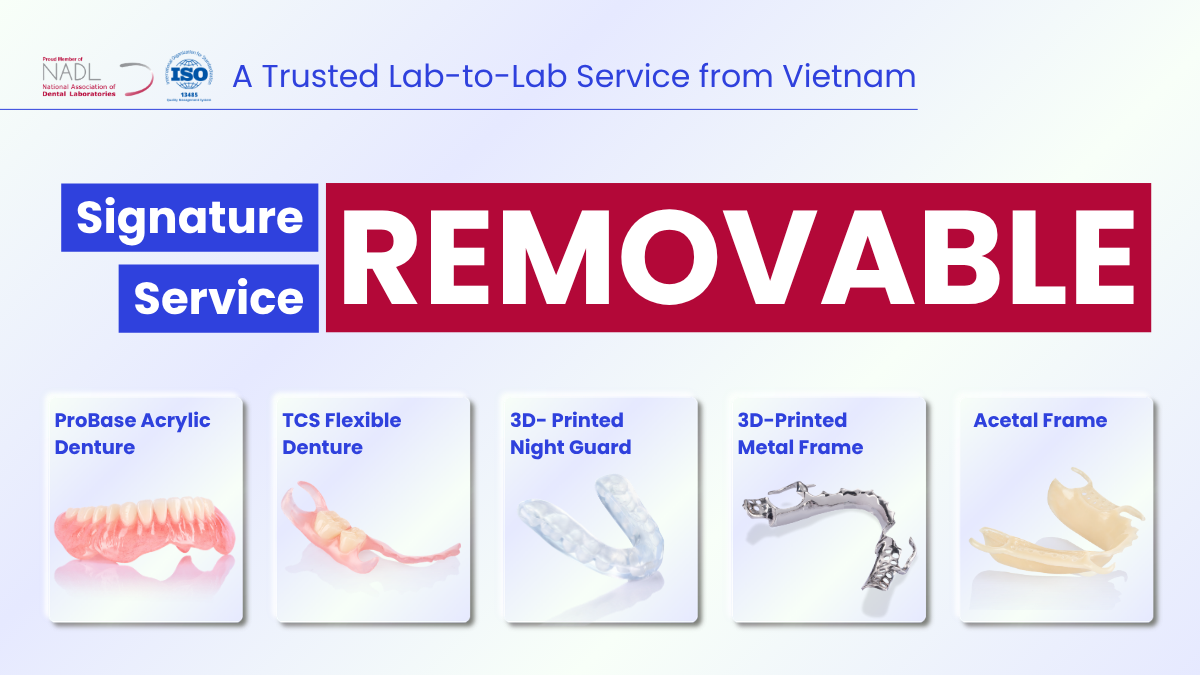
Our Commitments Built on “Trusted. Commitment. Quality”
- Commit to Large-Scale Manufacturing, high volume, remake rate < 1%.
- Commit to 5-Year Warranty
- Commit to Competitive Price
XDENT LAB | A Trusted Lab-to-Lab Service from Vietnam
Share this post:
Related Posts
Here is how a dental lab takes an implant case from scan to seated crown, and where each stage needs attention.
Learn about the VITA Classical shade system, an overview of the 16 VITA shades, and how XDENT LAB and its partners communicate shade technically.
See 5 Acrylic Partial Denture cases (cases 11 to 15) from XDENT LAB, a Vietnamese dental laboratory that is a member of the National Association of Dental Laboratories (NADL). XDENT LAB is an expert i...

